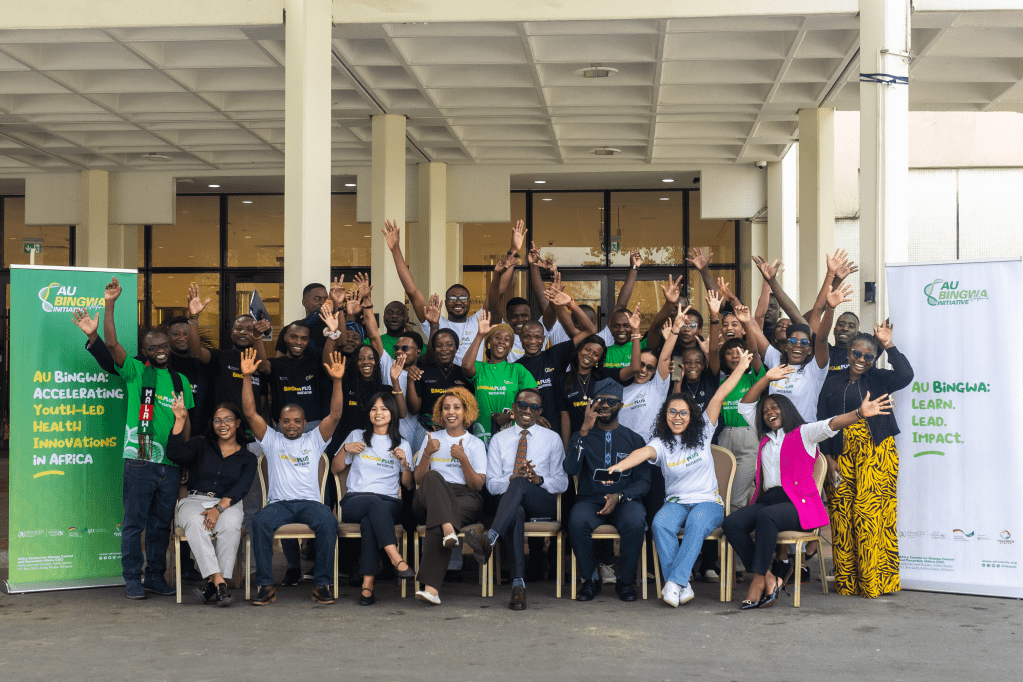
“The Bingwa+ program is not just another youth incubator. It is a bold intervention by Africa CDC, YouthHub Africa, and GIZ, that dares to do what many global and regional youth health programs fail to: trust young people with the resources to lead.”
At the International Working Group for Health Systems Strengthening (IWG), we were deeply honored to present one of our flagship initiatives at the Africa CDC Bingwa+ Y-Health program in Abuja, Nigeria, from the 27th to the 29th of May. Out of nearly 2,000 applicants, we were proud to be selected as one of the top 15 initiatives to receive seed funding—a powerful affirmation of our vision and work. In the blog post that follows, we reflect on our experience in Abuja and offer our perspectives on the Bingwa+ programme—its promise, its potential, and what it represents for youth-led health transformation in Africa.
The Bingwa+ program is not just another youth incubator. It is a bold intervention by Africa CDC Youth Division, YouthHub Africa, and GIZ African Union that dares to do what many global and regional youth health programs fail to do: trust young people with the resources to lead. Through a structured six-week capacity-building course, dedicated mentorship, and direct financial investment into youth-led initiatives, Bingwa+ is reshaping what meaningful youth engagement can and should look like.
At IWG, we are a youth-founded and youth-led think tank and policy institute working to reimagine health systems that work for all. We are a collective of individuals that convene, co-imagine, and catalyze efforts to strengthen our individual and collective toolbox of knowledge, perspectives, skills, and capacities to influence local and global health systems strengthening. One of our core mandates is to nurture a community that supports public health professionals as they navigate health systems across various stages of their careers, especially during the earlier stages. We provide a space for continuous learning and unlearning and collective action.
Many of us in the IWG community have participated in numerous youth development programs over the years. A common thread across these programs is that they often offer training and internships but stop short of offering real power, particularly the power that comes from decision-making autonomy and access to funding. Too often, young people are taught how to lead but are then sent back to their communities with empty hands.
This lack of trust is not benign. As Wong et al. (2021) argue in their commentary on young professionals in the public health workforce, youth exclusion is often tied to ageist perceptions, viewing young people as too inexperienced or disruptive to be entrusted with real responsibilities. The result is a cycle where youth are “engaged” but not enabled.
This must change.
Africa’s youth make up more than 60% of the continent’s population. Any strategy to tackle Africa’s health challenges that does not center this demographic is, by design, incomplete. Yet many youth programs still approach engagement in rigid, tokenistic ways, inviting young people to pre-defined spaces, under pre-set agendas, with little room to imagine alternatives or propose bold new pathways. When funding is involved, it is often minimal and insufficient to lead to real empowerment of youth and transformative solutions.
Programs like the Bingwa+ begin to break the mold.
By investing in youth-led solutions and giving young innovators a platform to pitch for actual funding, the program makes a radical yet simple statement: we trust you. We trust that you understand your communities. We trust that your ideas are viable. We trust that you can lead.
This trust is not misplaced. Across the continent, young people have and continue to sustain grassroots health initiatives, often with no external support. These projects—ranging from digital health campaigns to community-based services—are often run on passion, voluntary labor, and personal sacrifice. Scaling these efforts, however, is incredibly difficult without proper funding and institutional backing. The challenge is that most youth-led initiatives—especially in their early stages—don’t yet have the long track records, audit histories, or formal structures that many funding bodies require. As a result, brilliant ideas often stall not because of a lack of potential, but because the system is not set up to support them from the start.
The UN’s 2020 World Youth Report on Social Entrepreneurship and the SDGs highlighted this reality. It found that investing in youth-led social enterprises was not only crucial for achieving the SDGs but also a pragmatic response to global youth unemployment and underrepresentation in decision-making. When young people lead health initiatives, the impact is threefold: better health outcomes, new and creative ideas, and stronger leadership rooted in local realities.
“Limited access to start-up funds is considered the most pressing challenge for young social entrepreneurs, however, and inadequate access to technology among youth and other vulnerable populations (the digital divide) further exacerbates inequalities within and across countries.” UN 2020 World Youth Report
The Africa CDC Bingwa+ program stands out because it delivers what youth engagement efforts so often promise but rarely fulfill: a full ecosystem of support. Over six weeks, participants received rigorous capacity-building to sharpen their technical and strategic skills, were paired with experienced mentors for personalized guidance, and—most crucially—had the opportunity to pitch for targeted funding to support their initiatives. This integrated model reflects three essential pillars of meaningful youth engagement: capacity building, personalized mentorship, and resource allocation. Bingwa+ responds to this need with clarity and courage, creating a space where young people are not just invited to contribute to existing agendas but empowered to shape and implement their own.
We highlight courage here because it truly does take boldness, and it is risky, to invest in younger institutions and programs that may not yet have the track record of their more established counterparts. But that’s exactly the kind of risk we need institutions to take, because without it, we will never create space for youth-led initiatives to grow, thrive, and reshape the system.
What also stood out about the Bingwa+ program was the diversity of ideas represented. Unlike many incubator spaces that tend to center digital tools, mobile apps, or tech-based service delivery, Bingwa+ created room for a much broader spectrum of health innovation. As the IWG, our work is rooted in health policy advocacy and systems research, which doesn’t always align with the typical startup model. But innovation does not have one face. The current global emphasis on digital health solutions, while important, risks narrowing the definition of innovation and inadvertently steering young changemakers into predefined boxes, especially when funding and legitimacy are disproportionately tied to tech. Yet we need innovation everywhere, and youth voices belong in tech just as much as they belong in policy and research. By embracing this broader understanding, the program affirmed that there is no single pathway to impact, only the need for bold thinking and grounded solutions in every form they take.
Looking back on our experience with Bingwa+, one thing is clear: if we want to build stronger health systems in Africa, we need more programs like this. Not ones that just talk about youth empowerment, but ones that actually live it. Bingwa+ didn’t just give us training; it gave us trust. It treated young people as leaders and partners, not just learners. And while no program is perfect, this one got a lot right. We are excited to see how it continues to grow, and we will be cheering it on and holding it up as an example of what meaningful youth inclusion can really look like.
And now we call for more institutions to follow suit. It is time. Not just to engage African youth, but to fund them, trust them, and follow their lead.
Author
 International Working Group for Health Systems Strengthening
Leave a comment