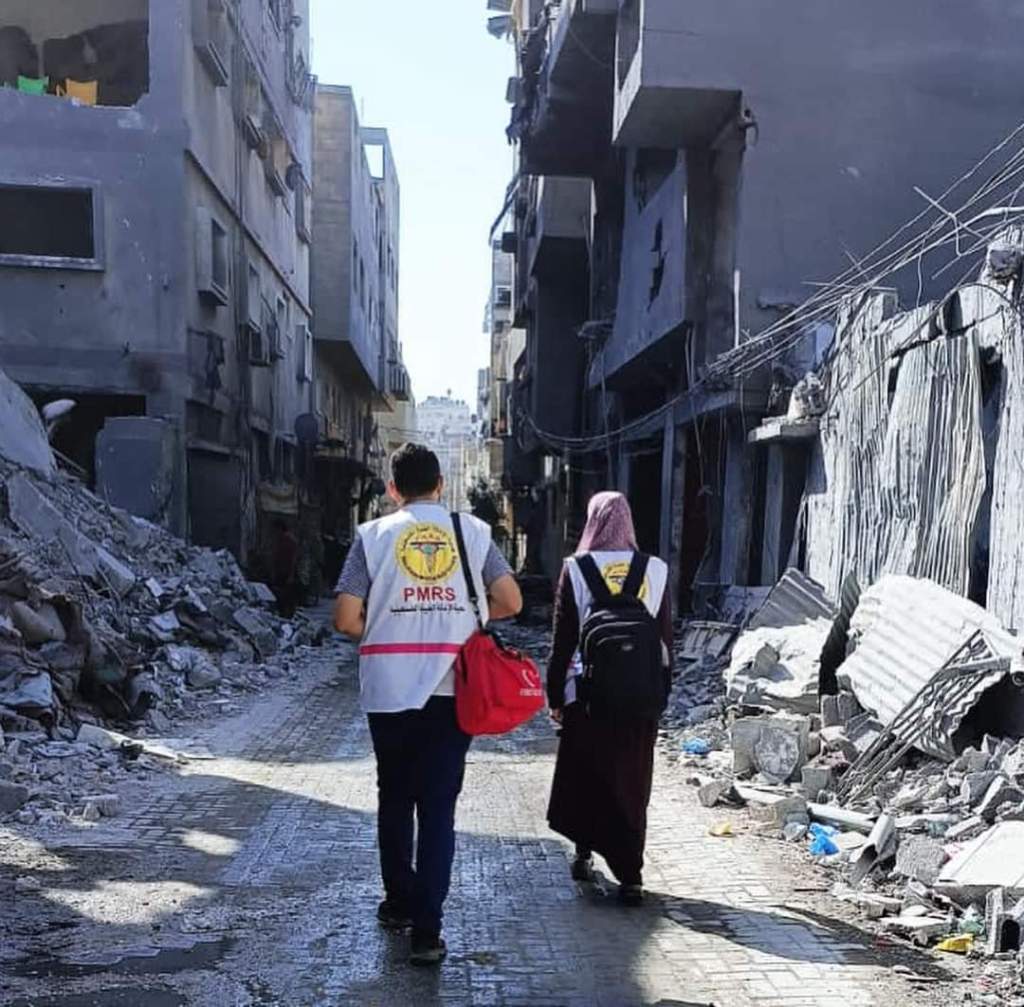
We urgently call on the global health community to unite in a powerful demand for a ceasefire and an immediate end to the attacks on healthcare facilities and workers in Palestine. The relentless attacks on healthcare workers in Gaza are emblematic of a broader, deeply troubling trend of targeting medical personnel and facilities in conflicts worldwide. These assaults not only inflict immediate suffering but also undermine the sanctity of international humanitarian laws, eroding the very principles established to protect humanity from the gravest injustices. This moment is critical, not only for the Palestinian people but for humanity as a whole. – Dr Duha Shellah, and Ms Sabreen Abdeellah
This editorial is an urgent and decisive call to collective action for a unified movement to safeguard healthcare workers in Gaza. Ten months into the war, the brutal hostilities we are seeing in Gaza and Palestine more broadly are exposing a terrible truth, as noted by more than 413 humanitarian organizations around the world: “ We are living in an era of impunity. Attacks that kill or injure civilians, including humanitarian and health-care personnel, are devastatingly common. Yet despite widespread condemnation, serious violations of the rules of war too often go unpunished.”
As public health professionals on the ground in Palestine, we urgently call upon every health and public health organization and association worldwide to unite in a powerful, coordinated effort to safeguard the lives and rights of healthcare workers (HCWs) in Palestine. Despite the tireless efforts of numerous movements, initiatives, and groups that strive to amplify the voices of Palestinians on the frontlines—those who are working against overwhelming odds to save lives in the face of mounting casualties and a collapsing health system—the crisis persists, worsening by the day. The status quo is no longer tenable, as the ongoing devastation continues to escalate, pushing the situation to catastrophic levels.
Despite efforts by some international health bodies to hold the Israeli Occupation accountable for their blatant violations of International Humanitarian Law, the relentless attacks on hospitals, medical facilities, and healthcare workers persist. The rights to health and human dignity for over 2.2 million people in the Gaza Strip are being grossly violated. The deliberate dismantling of the health system, the drastic reduction in essential health and social services, and the severe deterioration of living conditions are not mere consequences—they are direct results of the ongoing violence and occupation, which have exacerbated the already dire humanitarian crisis in Gaza and across Palestine. After ten months of brutal warfare, the situation in Gaza has reached unparalleled levels of devastation, pushing the region to the brink of catastrophe: more than 40,000 Palestinians have been killed, and over 10,000 individuals remain missing under the rubble.
Israeli forces have systematically dismantled Gaza’s health infrastructure, severely limiting access to critical healthcare for the sick, injured, and displaced. The already strained healthcare system is further crippled by severe shortages of medical staff, supplies, and electricity. These relentless assaults have not only caused significant casualties among healthcare workers and civilians seeking refuge in medical facilities but have also overwhelmed hospital emergency rooms beyond their capacity, leading to burnout and extreme physical and mental exhaustion among the remaining healthcare providers.
Palestinian healthcare workers in Gaza embody extraordinary resilience, unyielding strength, and unwavering fortitude in the face of unimaginable adversity. Despite enduring relentless physical, mental, and emotional challenges, they continue to serve their communities, undeterred by the overwhelming hardships confronting them and the 2.2 million people in Gaza. Many of these brave professionals have lost their homes, some now living in tents, while others have endured the profound loss of friends and family members. Yet, despite these devastating circumstances and the ongoing conflict that has uprooted their lives, they remain resolute, committed to their mission of saving lives under the most harrowing conditions.

But like the people of Gaza, healthcare workers have faced unimaginable brutality—they have been detained, tortured, and killed. Some have been attacked while performing their duty of caring for patients. The UN Human Rights Office reports that 500 healthcare workers in Gaza have been killed. Out of 36 hospitals, only 16 are partially functioning, with the rest rendered completely inoperative due to severe bombardment and deliberate, repeated attacks. Moreover, 12 of these hospitals are only partially accessible due to insecurity or physical barriers, and the remaining 8 field hospitals are providing only the most basic life-saving services. Since October 7, the World Health Organization has documented 1,000 Israeli attacks on healthcare facilities across the Occupied Palestinian Territories, resulting in 737 deaths and 1,028 injuries. Of these attacks, 485 targeted healthcare facilities, 366 affected healthcare transport such as ambulances, and only 43% of primary healthcare centres and 25% of UNRWA health centres remain functional, while 159 new medical points have been established amidst these dire circumstances.
Disease continues to run rampant in Gaza. With 350,000 people suffering from chronic diseases, the lack of access to vital medicines, supplies, and healthcare services has reached a critical level. Infections such as acute diarrhoea, exacerbated by severe malnutrition, along with acute respiratory infections, lice, scabies, skin rashes, chickenpox, and acute jaundice syndrome, are rampant. Two hospitals have been completely flattened, three paediatric hospitals have ceased operations, and facilities providing cancer and psychiatric treatments have been severely damaged. The relentless attacks on medical facilities have forced surgeons to operate under appalling conditions, often having to discharge patients with serious ailments before they are fully healed. Humanitarian aid and essential medical equipment are being severely restricted from entering the Gaza Strip, further compounding the already dire healthcare crisis.
Under international humanitarian law, health establishments and units, including hospitals, are inviolable and should never be targeted—yet, in Gaza and across Palestine, these protections have been flagrantly disregarded. The law mandates that the wounded and sick, as well as medical staff and transport, be shielded from harm. However, in Gaza, these protections seem meaningless. Healthcare workers, ostensibly safeguarded by international law, find themselves in constant peril. The escalating insecurity, coupled with the destruction of roads and infrastructure, and the failure to properly facilitate humanitarian missions, have severely impeded access to essential healthcare. A sustained and functional deconfliction mechanism is urgently needed to ensure the safe delivery of humanitarian aid throughout the Gaza Strip.
We are confronting a profound moral and ethical crisis. The relentless attacks on healthcare workers in Gaza are emblematic of a broader, deeply troubling trend of targeting medical personnel and facilities in conflicts worldwide. These assaults not only inflict immediate suffering but also undermine the sanctity of international humanitarian laws, eroding the very principles established to protect humanity from the gravest injustices. The international community bears a significant responsibility to uphold these laws and to ensure the protection of healthcare workers wherever they serve. The ongoing war, compounded by enduring economic and political challenges, has created a humanitarian catastrophe of immense proportions—one that demands immediate and sustained intervention.

We urgently call on the global health community to unite in a powerful demand for a ceasefire and an immediate end to the attacks on healthcare facilities and workers in Palestine. While the many initiatives from health organizations and healthcare workers for Palestine are heartening, they are not enough. What we need now is collective action—a unified global movement that amplifies and coordinates these efforts to ensure the protection of Gaza’s healthcare workers. From official bodies representing healthcare workers to global governance structures and influential voices in public health, every professional in this field must raise their voice in solidarity. This moment is critical, not only for the Palestinian people but for humanity as a whole. The current fragmented and scattered initiatives, while well-intentioned, are insufficient and face too many constraints to be truly effective. Those who dare to join the cause often face backlash, risk losing their jobs, or are subjected to boycotts, but the gravity of this crisis demands that we stand firm and united.
To drive home the urgency of our call to action, we will be capturing and sharing the raw, unfiltered stories of the healthcare workers who stand on the frontlines of Palestine’s relentless struggle. These narratives are not just accounts of their daily battles against overwhelming odds; they are powerful testaments to the indomitable spirit and humanity of those who refuse to falter, even as the world around them crumbles. By bringing their voices to the world, we aim to do more than highlight the dire need for immediate intervention—we seek to honor these unsung heroes, whose courage and sacrifice embody the very essence of what it means to serve humanity in its darkest hour. Through their stories, we hope to ignite a global response that is as resolute and unwavering as the resilience of those who continue to fight for life and dignity in the face of unimaginable adversity.
This is a critical moment for humanity, and it demands our collective, unyielding action to preserve the sanctity of international humanitarian principles and protect those who risk their lives to save others.


 International Working Group for Health Systems Strengthening
Leave a comment